
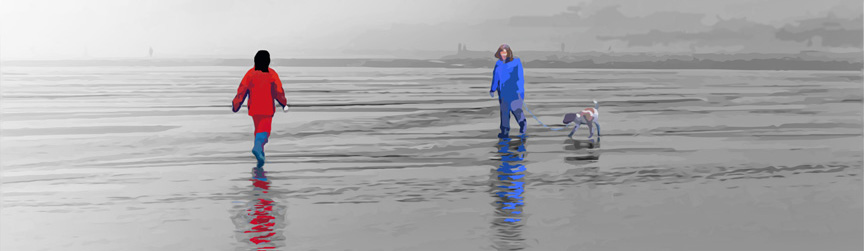
Landscapes Shaped by Geology and Climate
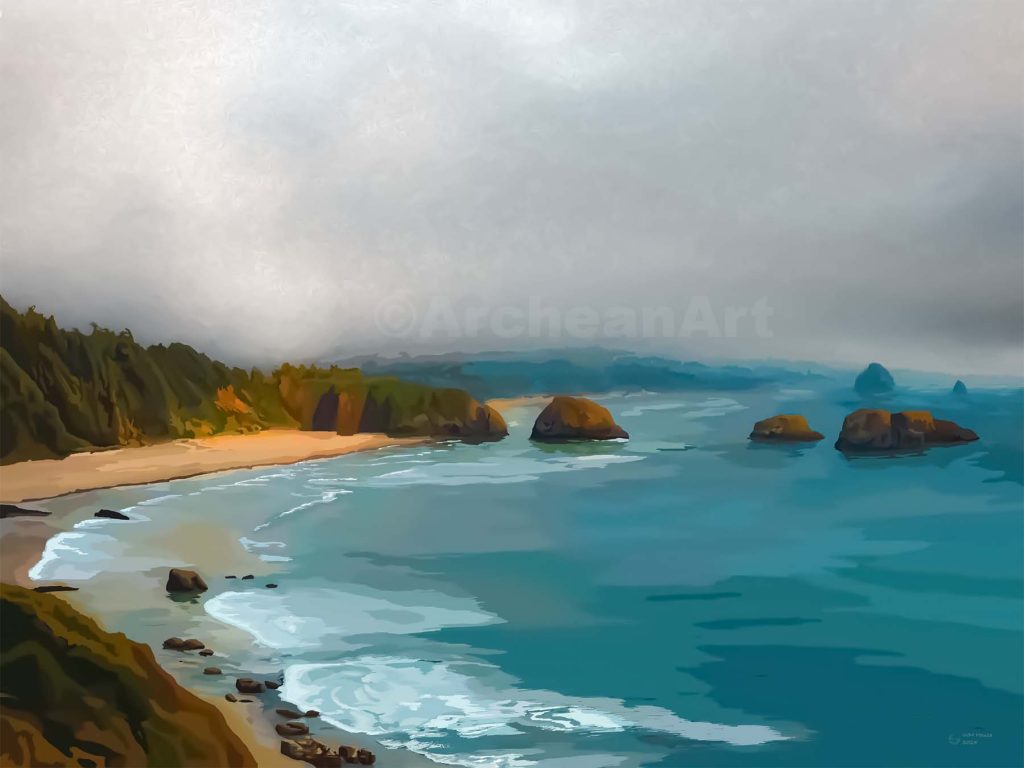
(The foreground was sketched and hand-painted in Adobe Fresco using a digital pastel pixel brush. The final artwork was created using stacked transparent layers painted with the individual background and foreground features. The sky was modeled separately in Topaz Studio using an original photo.)
I recently returned from a visit to Southern California, where I spent a day at Moonlight State Beach in Encinitas, just south of Oceanside, California. Coming from the cool, wet, rainy February weather of the Pacific Northwest, I was delighted to enjoy the 70-degree, sunny vibes of SoCal. An afternoon strolling long stretches of beach and wading in the Pacific Ocean surf left me relaxed; it was just what the doctor ordered to relieve the winter blues.
I couldn’t help but notice how the coastal California beaches merged one into another, forming a long continuous ribbon of sand squeezed between the water’s edge and coastal cliffs, with all manner of homes perched high above the beach. Occasionally, I spotted a house with its back deck collapsed midway down the tan sandstone cliffs, a reminder to enjoy your oceanside home while you can.
A variety of ingenious structures were visible during my walk, each one fighting to preserve the integrity of the cliff face and save the home above. Massive 30-foot-tall wooden retaining walls, set into the mid-slope of the cliff, were struggling to prevent the upper cliff face from collapsing. In other places, the base of the cliff was lined with small-car-sized boulders to ward off winter storm waves from eating away the soft rock at beach level.
All these structures formed a valiant but futile effort to thwart Mother Nature. The telltale sign was written into the surf at the base of a sloping beach. There, when the waves retreated seaward to the ocean, flat slabs of solid rock were occasionally exposed. The sad reality is that not long ago, those slabs were the base of the cliffs that had now retreated forty feet inland. In the battle between Mother Nature and beachfront homeowners, Mother Nature is always the winner. All attempts to halt the landward erosion of the cliffs are merely delaying the inevitable.
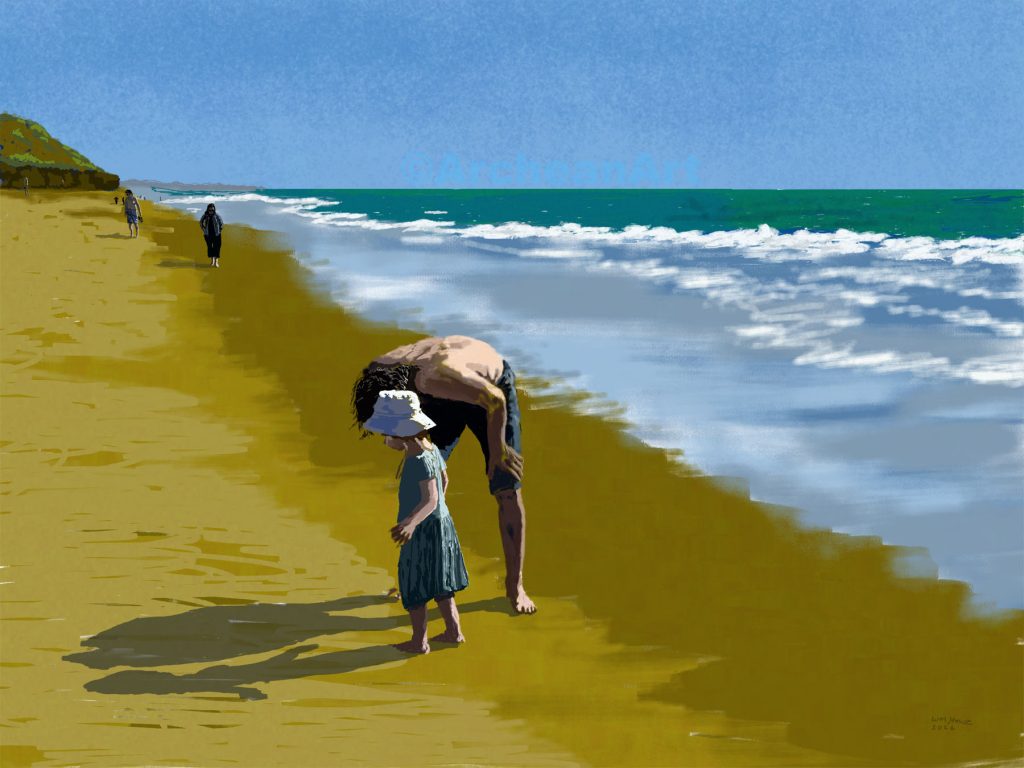
(A father and his daughter enjoy a day at Moonlight State Beach. The tide is out, setting the stage for serious beach walking or perhaps building sand castles with bright plastic buckets and small kids’ shovels. Sketched and painted in Adobe Fresco with hard pastel brushes, using stacked layers.)
I couldn’t help but contrast Moonlight Beach with the Northern Oregon beaches where I spend most of my quality seaside time. It all comes down to geology. The low-lying coastal cliffs of Encinitas are composed of the soft, weathered Middle Eocene-age sandstone of the Torrey Sandstone and Del Mar Formations, which were deposited in ancient tidal channels and lagoons within a coastal environment. These rocks were not exposed to the high temperatures and pressures of metamorphism and are soft when compared to most igneous and metamorphic formations. They lack the resistance to weathering that one might desire in a cliff that you depend on to keep your home out of the ocean.
In contrast, the coast of northern Oregon is the home of massive headlands formed by the Miocene-age Columbia River Basalts. Fifteen million years ago, these rocks formed when a massive outpouring of magma in Eastern Oregon traveled across the state, flowed into the Pacific Ocean, and cooled into hard tholeiitic basalts. Later, these igneous rocks were uplifted, creating cliffs that today tower up to 600 feet above the ocean. (Tholeiitic basalts are fine-grained extrusive igneous rocks that contain plagioclase feldspar, clinopyroxene, and iron ore. They often contain glass but little to no olivine.)
Cove beaches are the mainstay of my visits to the Oregon coast; short crescent-shaped strips of sand, pinched between the ocean and the coastal range. They are mystical locations where landscapes often emerge from the mist and fog as you watch.
If you were to walk the coastline from Canada to Mexico, you would journey for 2,650 miles. A long stretch of paradise where the cold blue-green Pacific waters meet the seismically active landscapes of western-most America. Your travels would take you through an infinite variety of beach and coastal landscapes, each the result of millions of years of interaction between geology, hydrology, and climate.
(Written and Posted in March 2026)
The feature image is part of my current art project: Traversing the Oregon Coast
For more artwork visit ArcheanArt at GeoGalleries:


Etsy